2021- 2022 Cohort
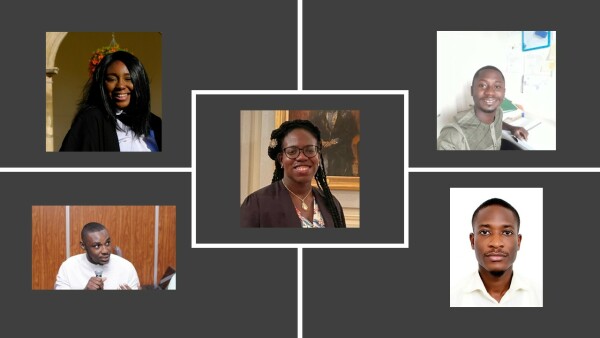
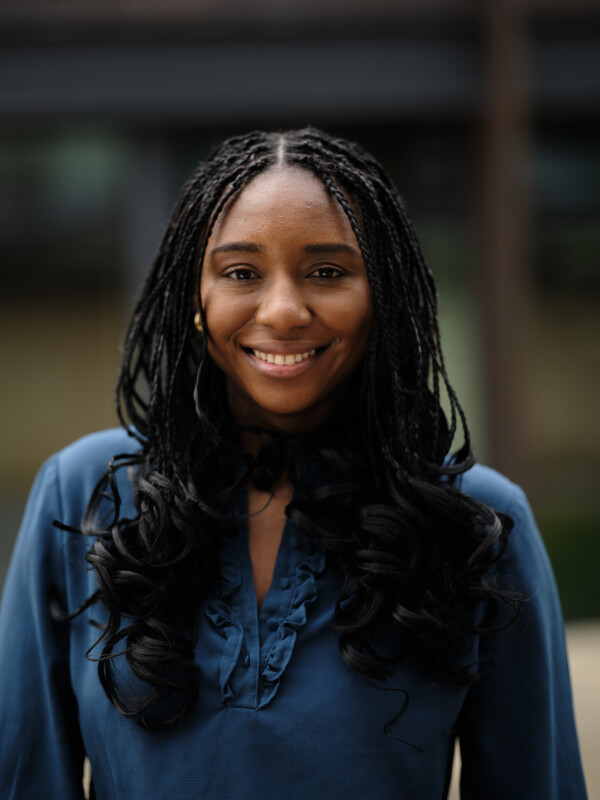
These are photos of the fourth cohort of PhD students sponsored by Cambridge-Africa when they started in the academic year 2021/2022.
Starting from top left: Kenechukwu, Mark, Yaw, Mohammed and Chisom (centre)
Find out what they are up to below:
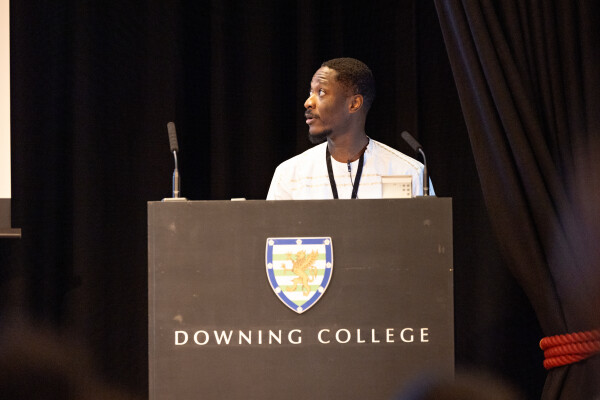
Yaw Ofosu Ansong Sir
|
Full name |
Yaw Ofosu Ansong Snr |
|
Department where you did your PhD |
Electrical Engineering |
|
PhD supervisor |
Dr. Chris Proctor / Dr. George Malliaras |
|
Title of PhD thesis |
Thick Conducting Polymer Coatings for Safe Electric Field Delivery to the Spinal Cord |
|
Year of study (start year – finish year) |
2021 - 2025 |
|
Current place of employment |
N/A |
|
Position at place of employment |
N/A |
|
Email address |
yoa21@cam.ac.uk |
|
Where are you at the moment? |
|
I recently submitted my PhD thesis and successfully defended my viva. I am currently in a transition period, preparing to move into a new role in medicine and or engineering. In the meantime, I spend most of my time engaging in activities I enjoy, such as sports, leading my startups, and music. |
|
Tell us about your time at the University |
|
I am a licensed medical doctor by training. Prior to starting my PhD, I was working as a doctor while also managing my healthcare technology startup. I have long been deeply interested in the intersection between medicine and engineering, and I chose to pursue a PhD in Engineering, with a focus on neurotechnology, because it is a pioneering field with significant potential to improve the understanding and treatment of neurological conditions. I chose Cambridge because it offered the right balance of academic excellence, entrepreneurship, sport, world class facilities, and mentorship. One of my most enduring memories from the programme was the moment I was finally able to demonstrate that the device I built functioned as intended. Prior to this, the existing literature suggested that such a device designed to scale electrochemical performance would not be feasible. This was a bold and uncertain risk, and I am fortunate that it ultimately proved successful. I still remember how excited my supervisor was when I should him the first preliminary results. We subsequently filed a patent for the device. Beyond my academic work, I was actively involved in entrepreneurship during my first two years at Cambridge. I founded and led the enterprise society at my college, Lucy Cavendish, where we organised several successful programmes. The society supported and mentored students interested in entrepreneurship through strategic collaborations and regularly hosted events featuring senior executives from leading organisations, including Apple and Google Health. Music also played a significant role throughout my studies. I had the opportunity to perform at my college on a few occasions, but most often, I played informally with close friends and for loved ones or, for personal reflection in the music room. The music room was one of my favourite hideouts. Music remained a consistent part of my daily routine, and I spent considerable time in the music room. Another major highlight of my time at Cambridge was boxing. The club became a second home to me, and I competed in university bouts, ultimately earning the Full Blue medal, the highest sporting honour, awarded to athletes at the University of Cambridge. Joining the boxing club was one of the most valuable decisions I made. I could talk all day about the benefits of boxing and why everyone should experience boxing. |
|
Tell us about your experiences since leaving the University |
|
My immediate goal is to return to clinical and or engineering work. Alongside this, I intend to continue developing my startups. One of my proudest achievements to date is my health care technology company, Summer Health Limited. Although we are a small team, we have accomplished a great deal with limited resources and have formed partnerships with several reputable institutions. This journey has been both challenging and rewarding. Looking ahead, I am excited about the opportunities that lie before me. I am committed to further advancing work at the intersection of healthcare and technology. |
|
Alumni wisdom |
|
You would be surprised at how literally everyone in Cambridge is impressive. Almost every conversation I had left me in awe. You meet people working on life-changing ventures and individuals with exceptional skill sets. I cannot stress enough the importance of being intentional about speaking with others, with the goal of building meaningful connections. It’s Cambridge. Everyone is impressive. As for words of encouragement, I’d say always remember why you started the journey. Maybe it’s for your mum, or for yourself, or for another loved one. Whatever the reason may be, you’ll need that reminder in tough times. It helps build fortitude. |
|
Publications (if any) |
|
https://pubs.aip.org/aip/aed/article/1/3/036104/3352160/Thick-conducting-polymer-films-for-ultra-low
https://pubs.aip.org/aip/apb/article/7/4/046109/2919536/Finite-element-analysis-of-electric-field
|
Kenechukwu Nwagbo
|
Full name |
Kenechukwu Nwagbo |
|
Department where you did your PhD |
Education |
|
PhD supervisor |
Pauline Rose |
|
Title of PhD thesis |
The Politics of Public Private Partnerships in Education: An Analysis of Stakeholder Dynamics in Edo State, Nigeria |
|
Year of study (start year – finish year) |
2021 - 2025 |
|
Current place of employment |
Blavatnik School of Government, University of Oxford |
|
Position at place of employment |
Political Economy Specialist, Open Political Economy Analysis Programme |
|
|
|
|
|
|
|
Where are you at the moment? |
|
I am currently the Political Economy Specialist on the Open Political Economy Analysis (Open-PEA) programme at the Blavatnik School of Government, University of Oxford. Here, I apply the political economy tools and expertise developed during my doctoral research to help transform complex research into clear, accessible, public policy products. |
|
Tell us about your time at the University |
|
My time at Cambridge provided a really valuable opportunity to pause and think more deeply about the kind of work I had been doing for the past five years. Prior to the PhD, I was coordinating large-scale education partnerships in the conflict-affected regions of northern Nigeria, before managing a network of 50+ policy think tanks across Asia, Africa and Latin America. I had been moving between policy and practice for a while, and the PhD gave me the space to properly dig into questions I kept coming back to, such as how public-private partnerships in education actually work in resource- and capacity-constrained contexts. Outside of my research, I spent a lot of time building communities and organising events. I helped put together several conferences, including two flagship ones at the Faculty of Education and with the African Society. I mentored students and took up the position of President of the Standard Bank Scholarship alumni network in 2021, organising several in-person and virtual events for our network of scholars across Oxford, Cambridge and the LSE. In 2023, I founded the Politics of Education (POLED) Network and, together with my co-chairs, built it into a community of 50+ graduate researchers at the Faculty of Education. POLED has hosted high-level policymakers from the UK, Nigeria and Mexico, and we were lucky to receive Faculty funding to support the work. We are now working on publishing our first edited volume of papers on the political economy of education reform. Some of my favourite memories were the simple things—formals, hosting friends, punting on the Cam, boxing sessions (with fellow scholar Yaw!), and spontaneous cinema dates (helped by the fact it was only a few minutes away). It’s been a full and fulfilling experience, both academically and personally. |
|
Tell us about your experiences since leaving the University |
|
I was very lucky to secure my position at Oxford before I completed my PhD. I am now working on an interesting new initiative led by Professor Stefan Dercon and Dr. Peter Evans called the Open Political Economy Analysis Programme. We are exploring new frontiers by making political economy analysis (the study of how politics, power, incentives and other stakeholder dynamics shapes the process of reforms) more accessible to mainstream audiences. This type of analysis is usually done behind closed doors and used internally to inform donor strategies, or as part of private sector risk analysis, for example. However, we think there is merit in bringing these discussions out in the open when it comes to public policies and investments. As the Political Economy Specialist, my work here encapsulates the mission of the POLED network founded at Cambridge. This time, I am expanding my expertise beyond education to other growth and development sectors, to help unlock the effectiveness of progressive reforms in low-and-middle income countries. |
|
Alumni wisdom |
|
Cambridge is a treasure trove of human resources. Go out and meet people! |