
My Elective Placement in the Central African Republic
My journey in infectious diseases started in a lecture theatre in Cambridge, but has led me to some incredible places with uniquely complex epidemiological and population profiles. I began to study medicine in 2017, but decided to intercalate with a PhD in 2021 with Prof. Julian Rayner at the Cambridge Institute for Medical Research, focussing on P. falciparum in regions of Colombia with unstable transmission patterns. I returned to the 5th year of medical school in 2024, and students in this year are given an opportunity to complete an ‘elective placement,’ wherein they can explore medicine in a different context. I decided to approach colleagues at the Institut Pasteur de Bangui (IPB) in the Central African Republic to try and spend 1 month understanding the research and diagnosis of malaria in a hyperendemic region.
Across my time in Central Africa, I joined different laboratories to explore the scope and range of pathogen research in IPB, but through meeting local experts, I was also able to gain an insight into the unique opportunities and challenges of science in this region.
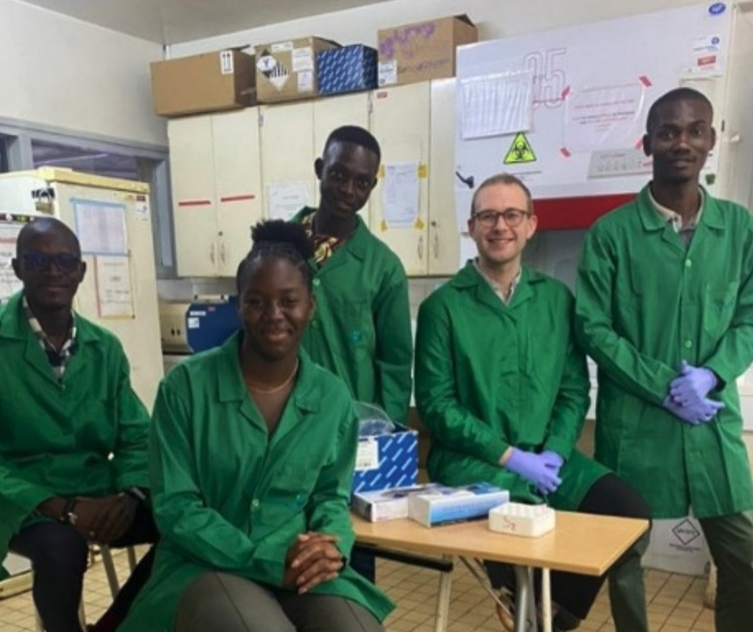
Under the guidance of Prof. Romaric Nzoumbou-Boko, head of the parasitology laboratory, I was able to see across the range of research at the IPB. I started by learning the process of Illumina sequencing with the Platforme Surveillance Genomique, who were engaged in sequencing Monkeypox and Varicella Zoster Virus genomes, and used this time to understand the opportunities and limitation in applying this platform to Plasmodium spp. genome sequencing. I then spent time with the clinical diagnostics laboratory, in part to complement my own clinical training. I learnt about the prevalence of haemoglobinopathies locally and how to carry out haemoglobin electrophoresis, Emmel’s Test for Sickle Cell Disease, and thick blood smears and Rapid Diagnostic Tests for malaria diagnosis. In the parasitology lab, I was able to take part in the ongoing projects, involving the detection of Angiostrongylus spp. locally, which can be a parasitic cause of meningitis, and on differentiating Plasmodium spp. by PCR, which is increasingly relevant given the recent increase in international travel to the country. These experiences offered a crucial insight into the healthcare infrastructure in the capital, and how local people interacted with healthcare services more broadly.
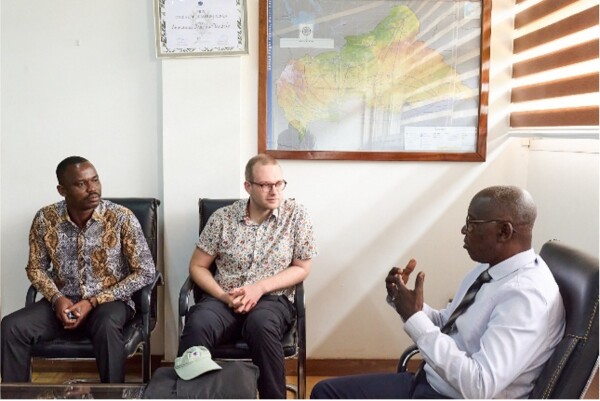
Left to Right: Prof. Romaric Nzoumbou-Boko, head of parasitology at IPB, Me, and Prof. Emmanuel Nakoune, director of IPB and virologist
Through being there in person, I was able to understand more about the challenges and scope for research in Central Africa. For a myriad of reasons, there has been a paucity of visitors from the English-speaking world, and I learnt acutely how anglocentrism in research can create barriers to accessing resources, and collaborations in the UK research environment. Indeed, this was the only time, to my knowledge, a member of the Cambridge research community has visited The Central African Republic and few have worked with colleagues in Central Africa overall. I hope I will be the first of many to see the opportunities for collaboration and building bilateral partnerships in this region.
By Kyle Michie