Research-informed professional development for secondary science teachers in Ethiopia
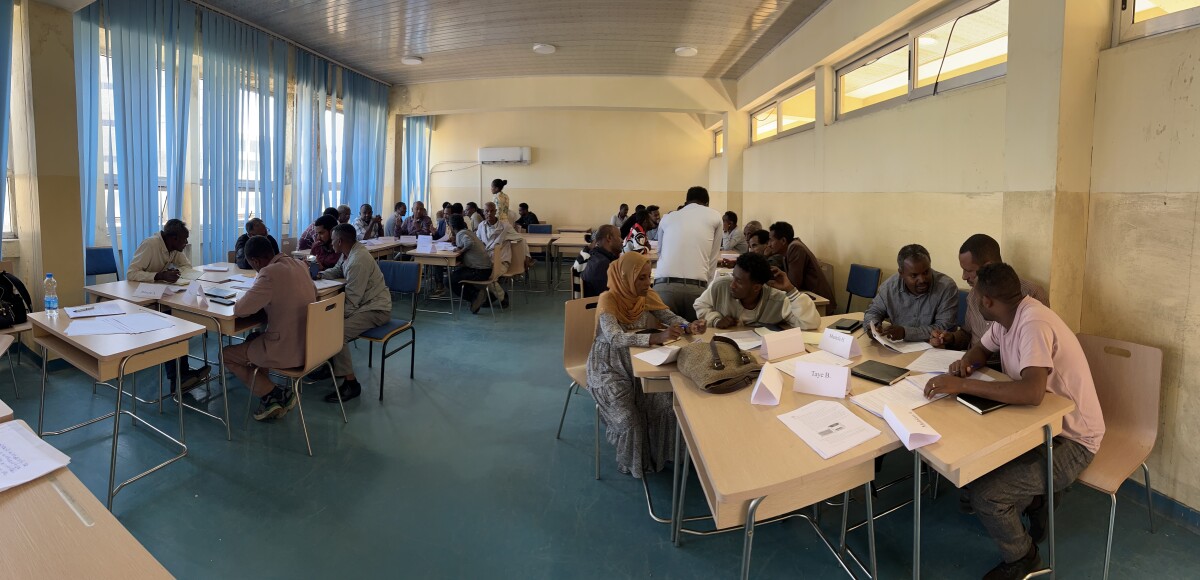
In early January 2026, secondary school physics and chemistry teachers in Bahir Dar, Ethiopia, came together for an intensive professional development programme focused on context-based science teaching, an approach that connects scientific concepts to students’ everyday lives, local realities, and real-world applications.
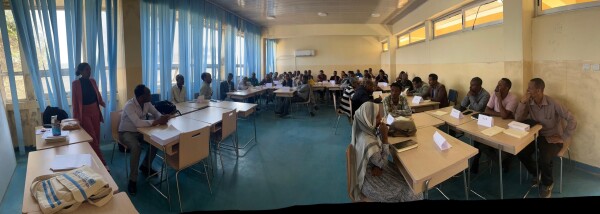
The training formed part of a Cambridge-Africa ALBORADA-funded collaborative research project between the REAL Centre at the University of Cambridge and Bahir Dar University. The project aims to strengthen secondary science instruction by supporting teachers to design lessons that make science more meaningful, relevant, and engaging for students.
The four-day training was led by Dr Dawit Asrat Getahun, the lead investigator from Bahir Dar University, in partnership with Dr Dawit Tibebu Tiruneh, the co-investigator from the REAL Centre, University of Cambridge. The programme was hosted at Bahir Dar University and involved 38 secondary science teachers and six school principals from five secondary schools across Bahir Dar city.
Research-informed professional development
The training was delivered in three rounds. The first sessions took place on 3-4 January 2026, with Dr Tiruneh supporting the delivery in person at Bahir Dar University’s main campus. These were followed by additional sessions on 10 and 17 January, led by Dr Getahun and the team at Bahir Dar University. This phased approach allowed participants time to reflect on ideas introduced in earlier sessions and to relate them to their own classroom experiences.
In advance of the training, the research team collected data in 2025 from participating teachers on their understanding of context-based teaching and learning, as well as their existing approaches to lesson design and classroom practice. As part of this collaboration, Dr Getahun visited the REAL Centre in November 2025, where he presented emerging findings from the research to Faculty of Education staff and postgraduate students. During the same visit, he also visited the Jack Hunt Secondary school in Peterborough and engaged with science teachers and school leaders to exchange experiences around science teaching and school improvement.
Insights from the research and these international exchanges directly informed the structure and content of the training to ensure the sessions were closely aligned with teachers’ needs, experiences, and classroom realities.
Engaging science teachers and school leaders
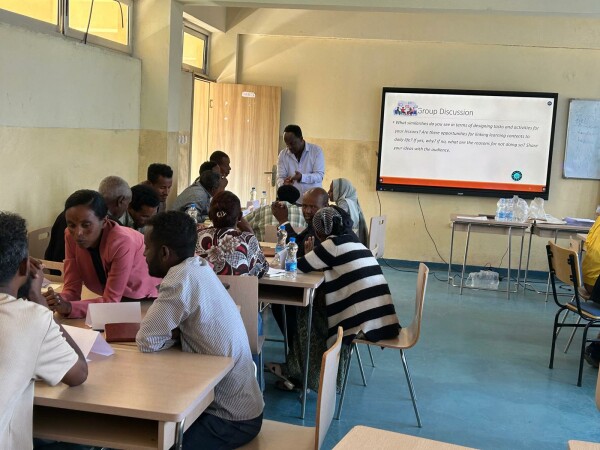
Across the four days, participants took part in interactive discussions, practical examples, and reflective activities focused on how context-based approaches can improve student engagement and promote deeper understanding of scientific concepts in physics and chemistry.
Both teachers and school principals welcomed the opportunity to exchange experiences with colleagues from other schools and to reflect collectively on practical strategies for strengthening science classroom practice.
Overall, the programme highlighted the value of research-informed, context-sensitive professional development and the potential of collaborative partnerships to support meaningful improvements in secondary science education in Ethiopia.
Acknowledgement
This collaborative research, including the international exchanges, is fully supported by the Cambridge-Africa ALBORADA research fund. The project is overseen by Professors Pauline Rose and Mark Winterbottom from the Faculty of Education at the University of Cambridge.
By Dawit Asrat Getahun (Bahir Dar University) and Dawit Tibebu Tiruneh (REAL Centre, University of Cambridge).