

Understanding How Farmers Share Banana Planting Material And Why It Matters
By Dr Renata Retkute, Department of Plant Sciences, Cambridge
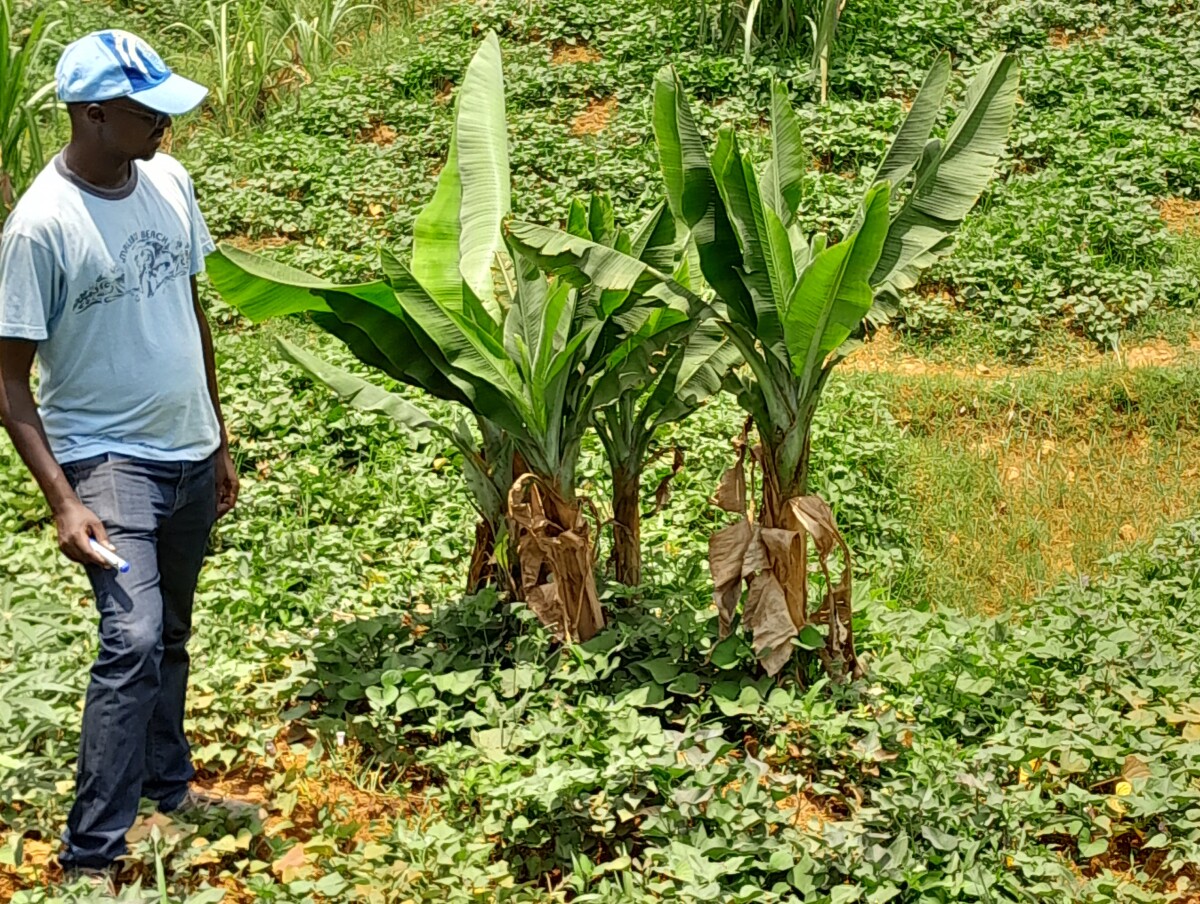
Banana and plantain aren’t just crops in West Africa — they are daily staples, key sources of income, and an essential part of rural life. In Benin, most of these crops are grown by smallholder farmers who depend on them for food and livelihoods. But their production is increasingly threatened by banana bunchy top virus (BBTV), a destructive disease that silently spreads from field to field.
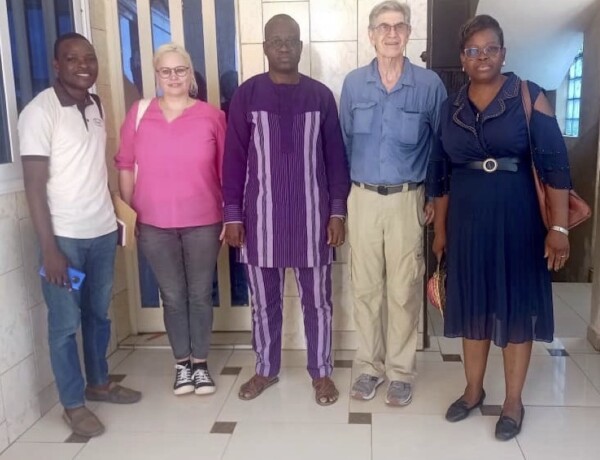
Conversations like this matter: meeting with Prof. Bruno Djossa (center), Rector of the National University of Agriculture, to strengthen partnerships, share ideas, and build the relationships that make collaborative research in Benin possible
Together with Dr Aman Omondi (Bioversity Alliance & CIAT, Benin/Rwanda) and Prof Martine Zandjanakou Tachin (University of Agriculture, Benin), I recently led a study exploring how planting material moves through farmer communities in Benin, and what this means for food security and livelihoods. Our work was supported by The Mastercard Foundation and the University of Cambridge Climate Resilience and Sustainability Research Fund, and this funding facilitated direct engagement with local partners and stakeholders, helping us build trust, align research priorities, and ensure that our work is grounded in local realities.
Bananas and plantains are grown from suckers, not true seed. This means that BBTV can travel unknowingly with the planting material farmers exchange. If a planting material is infected, the virus moves with it — often without farmers realising until it’s too late.
Our surveys show that most farmers get planting material through informal networks built on trust. Family, neighbours, friends, and local markets are the main sources. These informal systems are incredibly valuable: they help farmers recover after crop loss, try new varieties, or expand their production.
But they also allow BBTV to spread quickly across villages and landscapes.
By mapping seed exchanges across communities in Benin, we found that most sharing happens locally. However, a small number of farmers act as major hubs, distributing planting material over much longer distances. These farmers are crucial for maintaining access to planting material — and they are also key leverage points.
Targeting these hubs with clean seed, training, and disease surveillance could dramatically slow the spread of BBTV.
A central message from our study is that seed systems aren’t just technical pipelines — they are social networks shaped by everyday practices. Efforts to improve access to clean planting material and fight BBTV will work best when they strengthen, not replace, the informal systems farmers already trust.
Our findings underline the need for disease-aware, socially grounded seed system strategies that support farmers while protecting their crops.