Innovative Qualitative Methods Workshop for Early Career Researchers
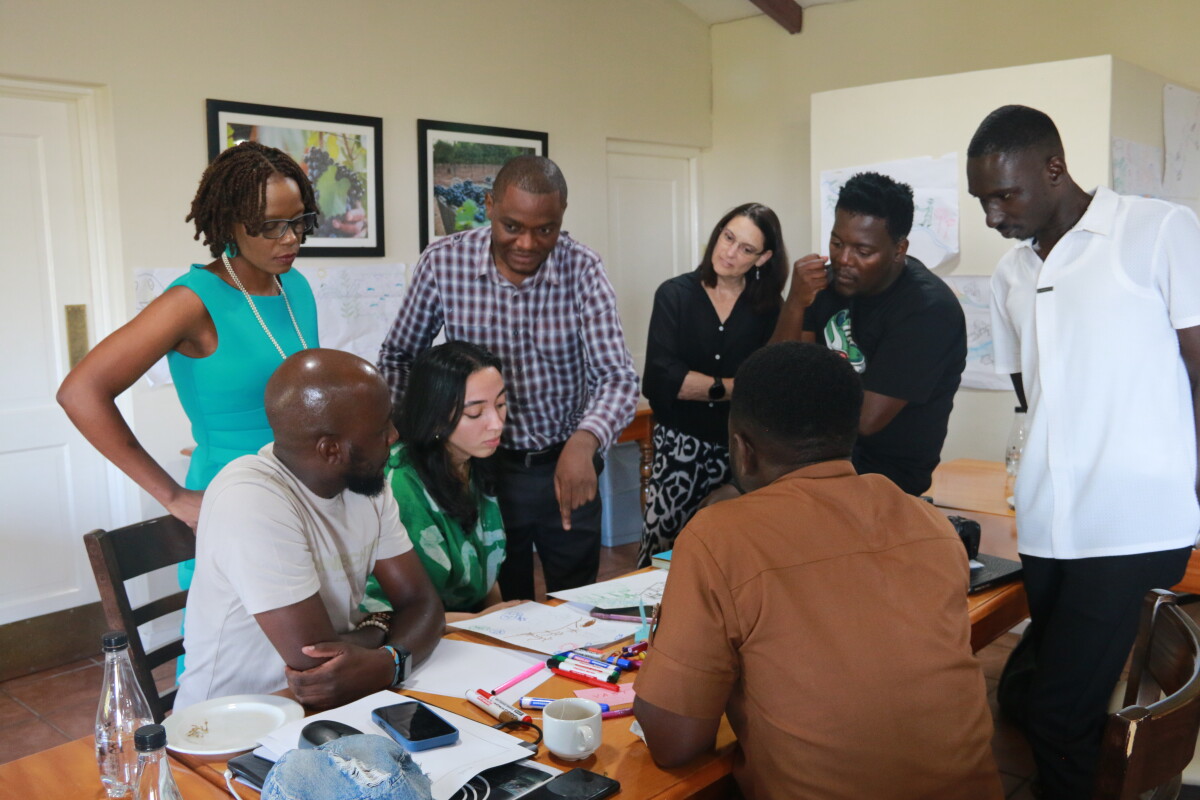
Dr Christina Culwick Fatti, Prof Fiona Anciano, and Prof Charlotte Lemanski
In March 2026, Professor Charlotte Lemanski (Cambridge Geography), Dr Christina Culwick Fatti and Prof Fiona Anciano (both University of the Western Cape Political Science) worked in collaboration to deliver the Innovative Qualitative Methods: New Approaches for Understanding Climate Resilience and Sustainability in Africa workshop.
This was generously funded by the Mastercard Foundation and the University of Cambridge Climate Resilience and Sustainability Research Fund, enabling us to bring together 13 early-career researchers from across Africa, representing nine nationalities. We hosted the workshop at the beautiful Zevenwacht wine farm on the outskirts of Cape Town, South Africa – and this semi-rural residential venue enabled us to take four full days out of everyone’s busy schedules to focus on methods training and practice alongside peer networking and mentoring.
The workshop was structured around a mentorship model, meaning that all participants benefitted from dedicated online mentoring sessions before and after the workshop. Nonetheless, the ECRs arrived on day one not knowing each other, with some having experienced exceptionally long and complex journeys (e.g. from rural parts of western Africa) requiring a mix of overland transport, flights, and overnight stays en route to Cape Town. However, by the end of the week – having been on a mutual journey towards recognising the value of participatory methods, and working in small groups to create their own stories – the group was a coherent team that had experienced life-changing bonds.
Despite the workshop coinciding with a major heatwave, the workshop started with presentations from all participants, and for the rest of the time participants engaged in hands-on training in participatory research methods. We particularly focused on storytelling and Photovoice as approaches to understanding and amplifying the lived experiences of communities affected by climate change.
The main highlight of the workshop was the opportunity for the ECRs to participate in the Photovoice Stories of Water and Energy Exhibition at the Isivivana Centre in Khayelitsha (Cape Town’s largest township). This was a large event, with presentations by academic researchers, photovoice participants, the city mayor and municipal officials. This provided an opportunity for the ECR workshop participants to comprehend how the participatory visual methods they had been learning about at the workshop, function in-practice.
The workshop also featured sessions led by invited speakers based in South Africa, including Prof Zarina Patel, Dr Suraya Scheba, Dr Mercy Brown-Luthango, and Dr Vanessa Masterson, who contributed insights from their work in participatory and community-engaged research.
All the ECRs commented on how transformative participating in the workshop was for their research, for the professional networks, and all returned to their home countries with a renewed passion for research and with new participatory methods skills to share with colleagues. Several participants subsequently produced publicly-available LinkedIn posts indicating their appreciation for the workshop, for example: Saviour Tepson Tepe, Waisiu Ayinde, Toka Hassan Taman, and Nicola Rule. Furthermore, one of the participants (Mussa) recently advised us that he successfully incorporated the storytelling methodology from the workshop training into a consultancy project capturing communities’ lived experiences of pollution in Malawi, and in securing the contract the client explicitly noted that his methodology was one of the strongest aspects of the proposal and helped distinguish it from other bids.
We are very grateful to the Mastercard Foundation and the University of Cambridge Climate Resilience and Sustainability Research Fund for making this workshop possible.