

Understanding Knowledge Generation from Secondary Data
Secondary data is an important source of knowledge that is used by researchers for enquiry about social realities. In Uganda, we had the opportunity to work with secondary data and publish a paper which investigated the associations between school infrastructure for Water and Sanitation Hygiene (WASH) and girls’ school attendance. Importantly, our work was based on a unique secondary data on citizen-led assessments through a collaboration between Kyambogo University (KyU) and UWEZO Uganda. The aim of the collaboration was to continue mining the data collected by UWEZO, for purposes of further identifying hidden patterns that can facilitate informed decision making by different actors (government, education partners and school management) so as to improve learning for children and young people.
For over two decades, citizen-led assessments have been collected in different countries in the Global South and research emerging from these datasets have been influential in understanding foundational learning across countries (for more information about this important movement please see the PAL Network). For the particular case of Uganda, UWEZO Uganda, which is a member of the PAL Network, has been promoting the use of their secondary data for research purposes through partnerships with universities. Given our experience with the use of secondary data, we were interested not only in how the data is used for knowledge production, especially by graduate students, but equally on how to assess the knowledge product (i.e. dissertations).
Currently, all graduate students at the School of Education at KyU use primary data for their degree programmes. The irony is that primary data is collected even when suitable secondary data like those from UWEZO, National Assessment of Progress in Education (NAPE) and other National Assessments, National Population and Housing Census Surveys, Demographic Health Surveys, Living Standard Measurement Surveys, or Multiple Indicators Clusters Surveys are available. This limitation to use of primary data restricts the scope of research by focusing only on a specific, potentially small group or contexts, and overlooks studies that can allow for more generalizability. Furthermore, primary data collection is time-consuming and resource-intensive, and tends to delay research progress and on-time completion.
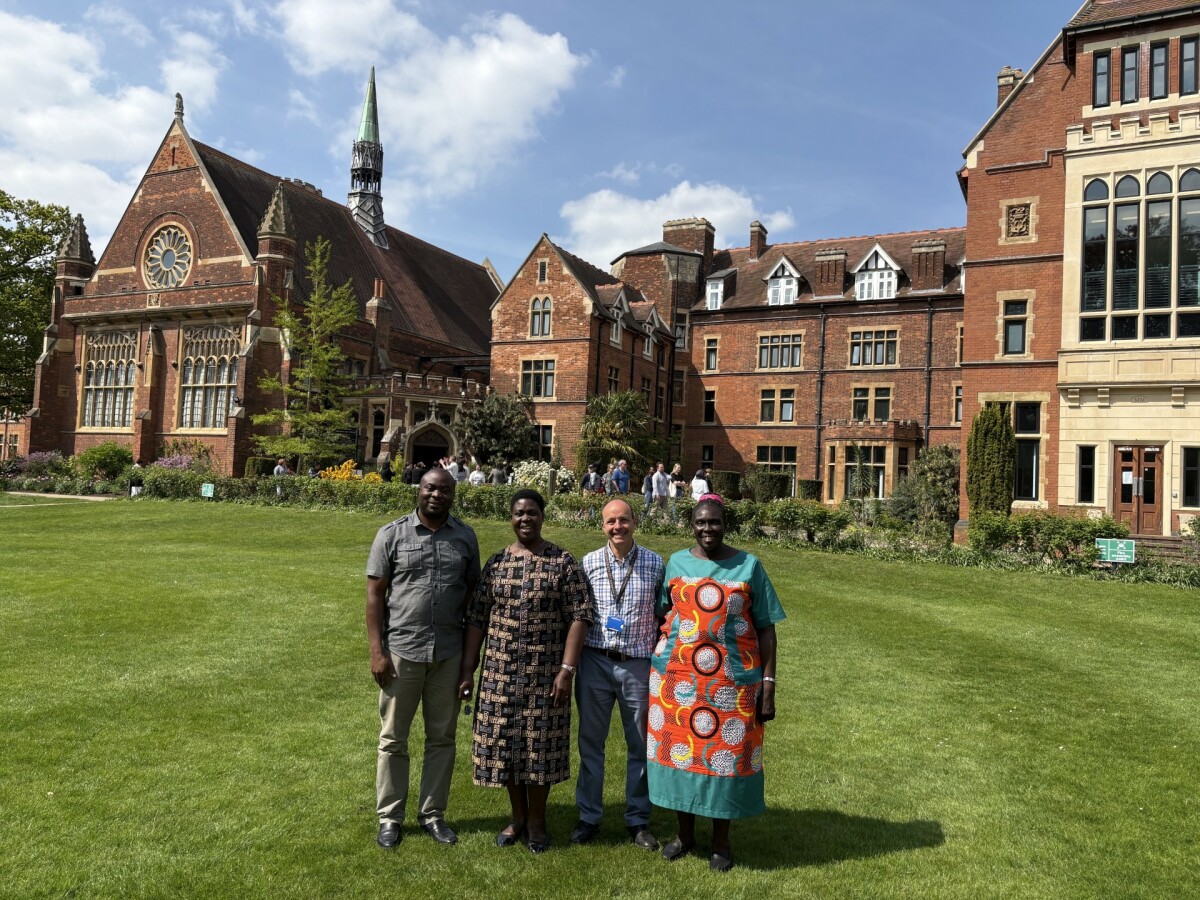
As part of our travel grant funded by the Cambridge-Africa Alborada programme, we had the opportunity to collaborate with Professor Ricardo Sabates Aysa from the Faculty of Education in Cambridge to exchange knowledge into how academic work based on secondary data is assessed for graduate programmes. The specific aims of the grant were to:
- Attend meetings with colleagues from the University of Cambridge, Faculty of Education who are experts in quantitative methods and the use of secondary data for summative assessment;
- Present results of their study at the University of Cambridge to students and staff, as well as the other communities interested in Education under the auspices of Research for Equitable Access and Learning (REAL) Centre;
- Attend other academic and social events at the Faculty of Education, and
- Discuss sources of funding specific to use of secondary data and brainstorm on areas of interest for further collaboration with the Faculty of Education, (REAL) Centre.
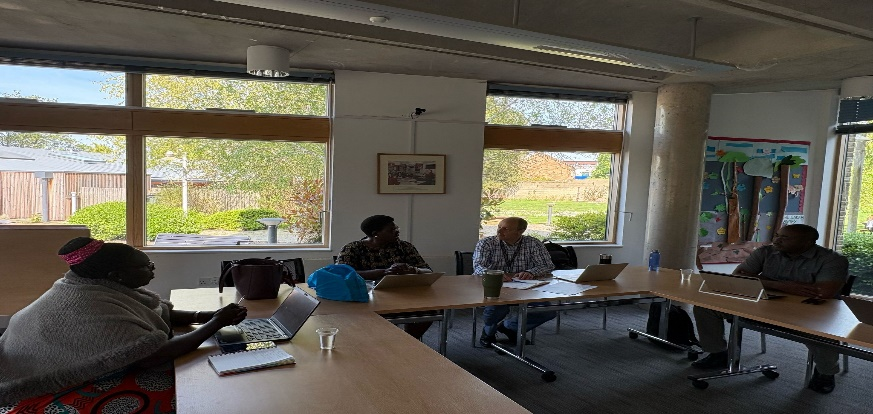
The key takeaways from our meetings with graduate students, as well as from reviewing past samples of students works using secondary data and discussing the possibilities of adaptations in our context, were:
- The duration of the Masters programme at the University of Cambridge, Faculty of Education is one academic year (9 to 10 months). This requires strict adherence to timelines by students and offers limited time to engage with primary data collection procedures and processes.
- Master’s dissertations in Cambridge are internally assessed. A sample of these assessments is validated by an external examiner during Exam Board. This contrasts with our current two years' Master's degree programmes offered by the School of Education at KyU, where Master’s dissertations are assessed both internally (two assessors) and externally. Over and above these assessments, the student is subjected to a viva-voce examination. While our students have more time to plan and design their own primary research, we have been experiencing a lot of delays and back log of graduate students, sometimes due to the nature of the primary research, as well as other student related and administrative challenges. The use of existing data sources and strict adherence to the principles of research and marking criteria could help to mitigate some of the obstacles that we face with timely completion.
- Several graduate students (Masters and PhD) at the Faculty of Education in Cambridge use secondary data for their research. The acceptable sources of secondary data are varied; internet sources, policy documents, interview data, survey data, administrative data, images, narratives, among others. Students are required to ensure the data is ethically acceptable and educationally relevant. The students are also required to critically engage with the data and to demonstrate extensive, in-depth and complex analytical processes in their work. The implication for KyU is that in promoting use of secondary data for our Masters and Doctoral programmes, we have to consider three important questions: (i) What are the acceptable sources of data? (ii) How will these data sources be examined (methodology)? (iii) What are the key ethical considerations to ensure that the research is done with the highest standards of integrity?
- Master’s students at the Faculty of Education in Cambridge have one supervisor and doctoral students have a supervisory team, usually a main supervisor and an advisor. Particularly for Master students, their supervisor does not have to be an expert in the use of secondary data. Supervisors are expected to be knowledgeable about the main principles of how these methods are utilised in practice. For doctoral students, their supervisory team aims to cover most of their research needs in terms of area of knowledge and methodological approaches. For the case of KyU, there are a minimum of two supervisors for both Masters and Doctoral students. The main supervisor is usually a specialist in the knowledge area. There is however, limited capacity of staff who are able to engage with diverse methodologies using secondary data sources. In this regard, we discussed the need to have capacity building in diverse research methodologies, which can ensure that more staff are trained in in-depth understanding of secondary data sources and methods, as well as their diverse applications.
- Assessment of research projects in the University of Cambridge is agreed by the different departments and faculties, in their teaching and learning committees and exam boards. Therefore, there is not a “one size fit all”. The opposite is the case for the School of Education at KyU where the mode of assessment of graduate research projects is centrally prescribed by policy and managed by the Directorate of Graduate Research and Training (DGRT). This means that in order for the School of Education at KyU to diversify its assessments and include the use of secondary data, approval must be obtained by the School from the Graduate Board and subsequently from Senate through the DGRT.
Upon return to Uganda, we developed a concept note for the Dean, School of Education for discussions at the Graduate Committee and subsequently, the Graduate Board. Among the key messages, we highlighted the need to diversify our assessments, broaden the sources of knowledge and information, as well as methodologies employed by our students, continue to develop methodological expertise in our School and to seek partnerships to enhance mutual learning about ways to supervise and mentor students, particularly with the use of diverse research methods that employ secondary data for analyses. We hope that the key lessons from our experiences can continue to guide discussions in our institutions about the use of secondary sources of data and assessments.
Acknowledgement: The authors are grateful for the funding from Cambridge Africa -Alborada Research Fund which gave us the opportunity to travel to the University of Cambridge to interact with expert academics in the Faculty of Education and the REAL Centre in collaboration with Professor Ricardo Sabates Aysa. The interactions we had over the period of the visit strengthened our understanding of the dynamics involved in the implementation of secondary data-based research. We were able to identify action points that Kyambogo University could follow in order to diversify our sources of data and assessments.
By Dr Joyce Ayikoru Asiimwe and Dr Elizabeth Opit, Kyambogo University
May 2026