
What Happens Beneath Our Feet? Understanding Soil Health in Cameroon's Changing Landscapes
Across Cameroon, fertile soils underpin food production, rural livelihoods, and ecosystem health. Yet soils are increasingly under pressure from agricultural expansion, population growth, and climate change. While these changes are visible above ground through changing landscapes and farming systems, their effects below ground often go unnoticed.
A collaboration between the University of Cambridge and the University of Dschang has been exploring what happens to soils when forests are converted into agricultural land, and whether these soils can recover over time.
Supported by the Cambridge-Africa ALBORADA Research Fund, the project focused on the forest-savanna transition zone of Central Cameroon, a region where forests, fallows, and agricultural fields coexist. These landscapes provide a natural laboratory for understanding how land-use change influences soil health and long-term agricultural sustainability.
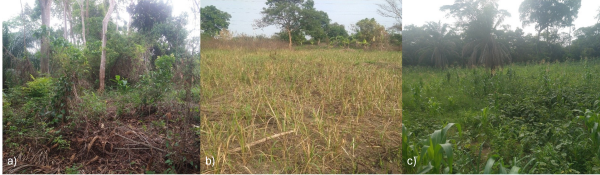
Representative forest (a), fallow land (b), and cropland (c) sampling sites in Foulassie
Healthy soils perform many essential functions. They store carbon, recycle nutrients, regulate water, and support plant growth. They also play an important role in climate regulation through carbon storage. When soils lose organic matter and nutrients, crop production can decline, ecosystems become less resilient, and communities become more vulnerable to environmental shocks.
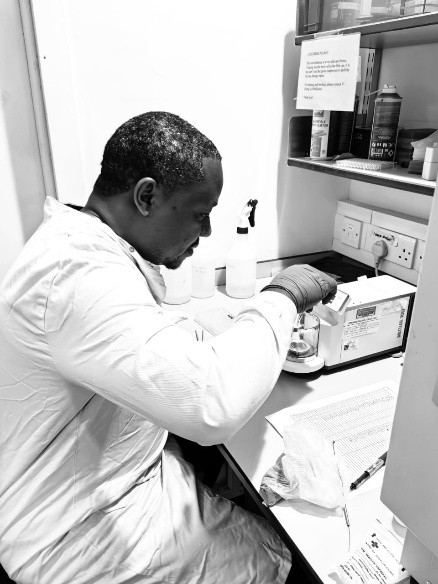
To better understand these processes, researchers from Cameroon and Cambridge worked together to collect and analyse soil samples from forests, fallow lands, and active croplands across the Obala region of Central Cameroon. In total, 146 plots distributed across 27 sites were surveyed and sampled.
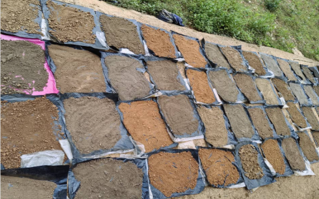
Soil samples collected in the field
The results revealed a clear pattern. Converting forest land to agriculture significantly reduced soil organic carbon and nitrogen, two key indicators of soil fertility. Agricultural soils contained substantially lower carbon stocks than nearby forest ecosystems, demonstrating the long-term consequences of land-use change on soil health.
The study also examined fallow lands, which are commonly used in many farming systems across Central Africa to allow soils to recover naturally after cultivation. While vegetation recovered visibly above ground, improvements in soil carbon and nutrient reserves were slower than expected. Even after several years, fallow soils had not fully regained the levels observed in natural forests.
However, there were encouraging signs of recovery. As fallows aged, root biomass increased significantly, suggesting that natural regeneration gradually rebuilds underground carbon inputs. These processes are largely invisible to the eye, yet they represent an important pathway for restoring soil functions over the longer term.
The findings highlight a challenge facing many tropical agricultural regions: how to increase food production while maintaining the natural resources on which agriculture depends. Protecting existing forests remains essential, but the results also point towards opportunities for regenerative land-management practices that can improve soil health while sustaining crop production.
Beyond the scientific findings, the project demonstrates the value of international research partnerships. Researchers from the University of Dschang and the University of Cambridge combined expertise in field ecology, soil science, laboratory analysis, and data interpretation. The collaboration also provided opportunities for training and strengthening capacity, particularly in soil-carbon assessment and environmental monitoring techniques.
The project has established a foundation for future collaborative research on soil fertility, carbon sequestration, and sustainable agricultural development in Cameroon.
As countries across Africa seek solutions to food insecurity and climate change, healthy soils will become increasingly important. The findings from Central Cameroon remind us that sustainable agriculture begins beneath our feet. Understanding, protecting, and restoring soils is not only an environmental priority, but also an investment in future food security, climate resilience, and sustainable development.
This work reflects the broader vision of Cambridge-Africa partnerships: bringing together researchers from African institutions and the University of Cambridge to address shared challenges through collaborative, locally grounded, and globally relevant research.