
When Staying Is an Adaptation: Lessons from the Histories of Landslides in Bududa, Uganda
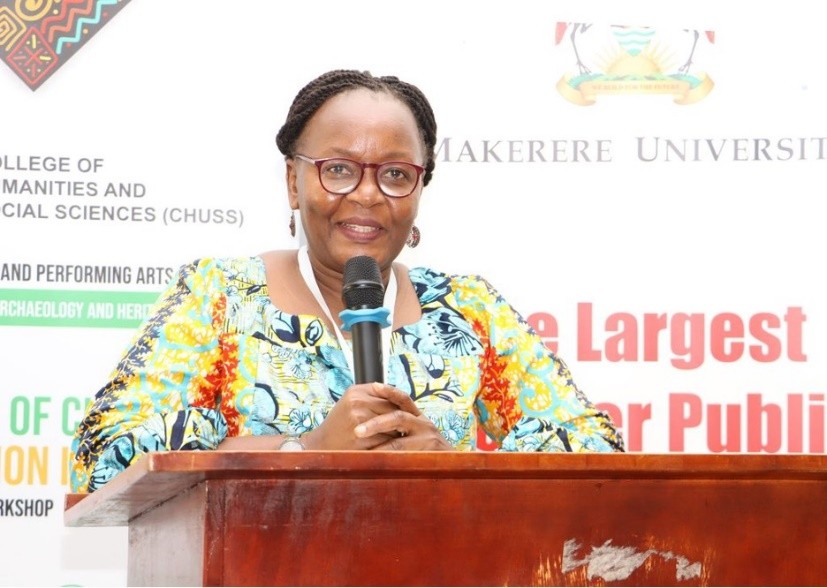
Wrote by Dr Pamela Khanakwa, Makerere University
The question of why people move, where they move to, and why others choose to remain in places exposed to environmental danger was among the issues that animated the three-day workshop on Histories of Climate and Migration in Uganda, held at Makerere University from 8-10 September 2026. Bringing together historians, social scientists, government officials, researchers, postgraduate students and representatives of refugee communities, the workshop created an opportunity to examine how environmental change has shaped human mobility and livelihoods in Uganda, both in the recent past and over longer historical periods.
Organized under the collaborative project between Makerere University and the University of Cambridge, with support from the Mastercard Foundation’s Climate Resilience and Sustainability Research Fund and the Cambridge-Africa Programme, the workshop sought to bring historical scholarship into conversation with contemporary experiences of climate change, migration and displacement. What made the gathering particularly interesting was the diversity of perspectives represented. Academic researchers engaged with policymakers and practitioners, while members of refugee communities brought experiences and forms of knowledge that are not always adequately represented in academic discussions of migration.
Across the 3 days, 32 papers were presented and a recurring question emerged: should migration always be understood as a consequence of environmental crisis, or can it also be a strategy through which people adapt to changing circumstances? Equally important was the question of what happens to those who cannot move, those who choose to remain and those who return after relocation. These questions became particularly evident during the panel, “Problems of the Present, Lessons of the Past: Examining Landslides in Bugisu,” which examined the historical experiences of communities living with recurrent landslides in the Mount Elgon region. The panel brought together five presentations examining the relationship between landslides, environmental change, livelihoods, indigenous knowledge, migration and government intervention. Rather than treating landslides as isolated natural disasters, the presentations demonstrated how environmental hazards are embedded in longer histories of settlement, agricultural production, community knowledge and state responses.
These presentations challenged the assumption that adaptation necessarily means moving away from environmental danger. Staying, returning, changing agricultural practices, diversifying livelihoods, drawing on indigenous warning systems and negotiating with government institutions can all form part of how communities respond to environmental hazards. The discussion following the presentation were equally important. Participants questioned indigenous ecological knowledge changes over time, how reliable local warning indicators are under changing environmental conditions, and how migration itself transforms the composition and identity of communities. There were also calls for greater conceptual and empirical precision particularly in distinguishing climate change, environmental change and landslides instead of treating them as interchangeable explanations. These exchanges showed that beyond documenting past experiences, historical research requires interrogating the concepts and assumptions through which those experiences are understood. The Bududa panel provided a useful case through which to examine adaptation, and its discussions resonated with the wider conversations throughout the workshop, including keynote addresses by Prof. Anthony Mugere of Makerere University and Mr. Mwenyi Davis, Commissioner for Relief, Disaster Preparedness, and Management in the Office of the Prime Minister of Uganda.
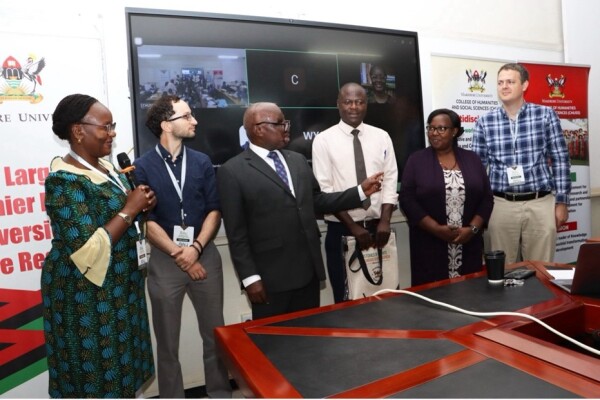
The refugee roundtable chaired by Dr. Samuel Meyerson elaborated on similar themes. This session placed the experiences and intepretations of refugees and host communities at the centre of the discussion. Representatives from Nakivale and Kyangwali Refugee Settlements, alongside a representative of the host community in Isingiro District, explained how environmental histories and community experiences are transmitted through songs, ceremonies, storytelling and community meetings. This prompted a discussion about whose knowledge counts as history and what may be lost when oral memories and lived experiences are translated into academic narratives. It was a powerful reminder that refugees and host communities are not just subjects of research or passsive recipients of policy interventions, but they are also producers and custodians of knowledge about environmental change, livelihood adaptation and mobility.
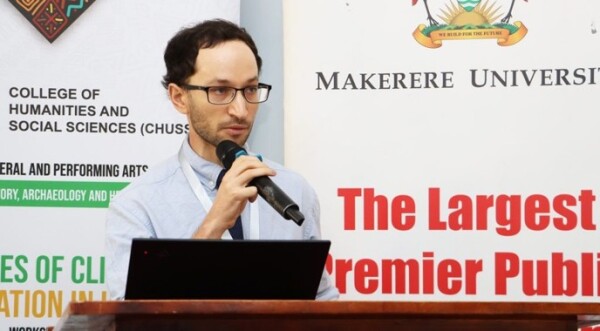
Dr Mayerson, University of Cambridge
One of the workshops’ most important contribution was the opportunity to bring different forms of knowledge and experiences into conversation. Discussions demonstrated the value of approaching climate and migration historically, while also showing that historical research has much to contribute to contemporary policy debates. The presentations on Bududa challenged a seemingly straightforward policy assumption that moving people away from environmentally dangerous locations necessarily makes them more secure. The experiences of those who stayed, returned, or maintained livehoods across different locations demonstrate that people’s decisions can hardly be separated from their relationships with land, economic opportunities, social networks and their ability to adapt to new environments.
Ultimately, the discussion over the three days left a question that extends beyond Bududa: what does adaptation mean when the choice to move is constrained, when remaining is economically necessary, or when people maintain connections across more than one place? The histories presented at the workshop suggest that there is no single answer. For some communities, migration creates opportunities for livelihoods diversification and security. For others, remaining is an active strategy rooted in attachment to land, access to resources, social relationships and the possibilities of sustaining a livelihood in familiar surroundings. In many cases people do both; they move, return, maintain multiple homes and negotiate belonging across different location. Therefore, understanding these experiences requires more than identifying environmental hazards or measuring population movements. It requires attention to the histories through which communities have understood their environments, the institutions that shape their choices and the unequal conditions under which adaptation takes place. As such, the workshop was valuable because it brought these dimensions together, while making space for conversations between researchers, policy makers, and the communities whose experiences were central to the debate. All in all, when staying is an adaptation, the challenge is not to ask why people refuse to move. It is to understand what makes staying meaningful, necessary or economically possible and also to recognize that meaningful adaptation must begin by taking people’s histories, knowledge and choices seriously.
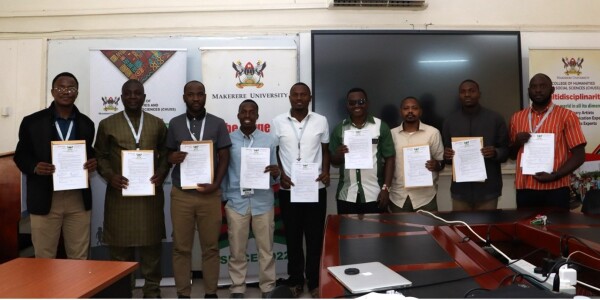
Workshop on histories of climate change and migration in Uganda was concluded at Makerere University with award of €18,000 in seed grants to nine beneficiaries